

Discover Your Perfect Skincare
Transform your skin with our clinically proven formulas designed for visible results.
What are Retinoids
Retinoid is the umbrella term for vitamin A derivatives, including retinol, the most well-known member of the family. Others include tretinoin, adapalene, retinal (retinaldehyde), tazarotene and retinyl esters, ranging from prescription-grade to very mild and stable.
Retinoids speed up cell turnover, the rate at which skin sheds dead cells. This process slows with age, so dead cells pile up and skin looks dull with wrinkles more pronounced. Retinoids restart it, surfacing fresh cells for a smoother, renewed look with fewer visible lines, wrinkles and pores.
How Retinoids Work in Skin
Retinoid Breakdown
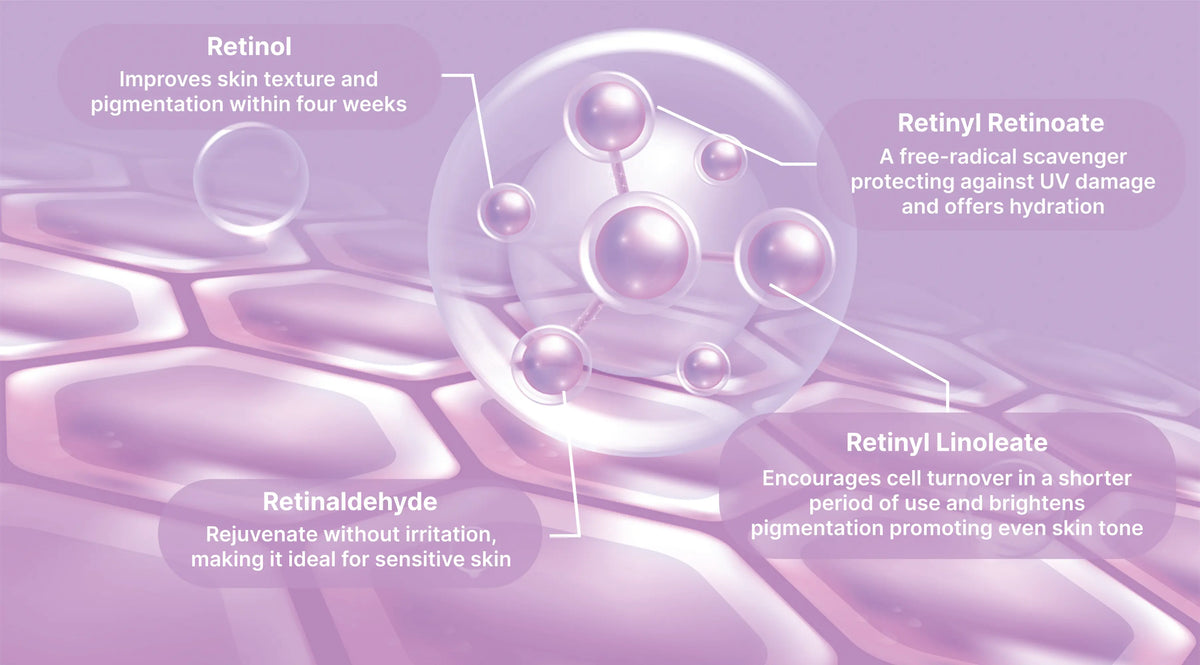
The raw starting material. Your skin can't use it directly, so it has to convert it into an active form first.
The family name for vitamin A derivatives. Each type sits a set number of steps from the active form, and that distance decides everything.
Furthest from active, three conversions away. The gentlest, slowest-building option. A soft landing for sensitive skin and first-timers.
Two conversions from active. The familiar all-rounder: real results at a strength most skin can build up to.
Just one conversion from active. Fast and powerful, yet still well tolerated. Near-prescription results without the prescription.
Already active, no conversion needed. The strongest, fastest-acting form, and prescription-only for exactly that reason.
The raw starting material. Your skin can't use it directly, so it has to convert it into an active form first.
The family name for vitamin A derivatives. Each type sits a set number of steps from the active form, and that distance decides everything.
-
Retinyl Esters
Furthest from active, three conversions away. The gentlest, slowest-building option. A soft landing for sensitive skin and first-timers.
-
Retinol
Two conversions from active. The familiar all-rounder: real results at a strength most skin can build up to.
-
Retinaldehyde
Just one conversion from active. Fast and powerful, yet still well tolerated. Near-prescription results without the prescription.
-
Retinoic Acid
Already active, no conversion needed. The strongest, fastest-acting form, and prescription-only for exactly that reason.
When to start using Retinols
The general consensus among experts is to introduce a retinoid serum in your mid-20s to early 30s. While there’s no rush, a gentle retinoid formula can be used as a preventative measure or to tackle early signs of ageing such as fine lines and reduced elasticity.
Powerful visible results
95%
reported a significant increase in skin radiance, glow, and luminosity.
20X
Better wrinkle reduction performance compared to lower baseline alternatives
50%
more skin collagen production
How to use Retinols
Step 1: Cleanse with Essential Cleanser to remove impurities and prepare the skin.
Step 2: Apply B5 Hydrating Serum to help hydrate and support the skin before your retinoid.
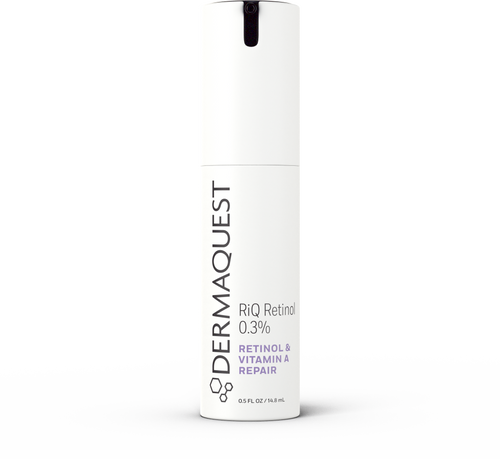
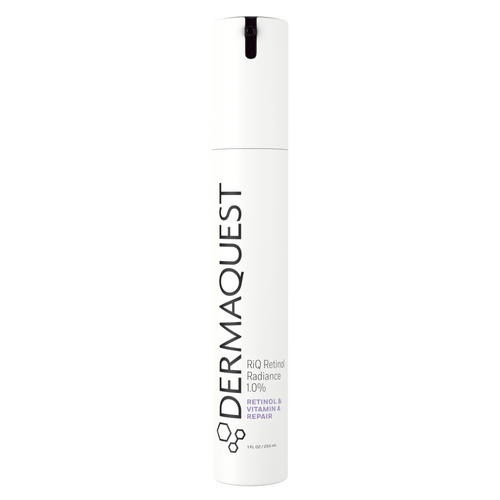
Step 3: Apply a thin layer of RiQ Retinol 0.3% to the face, neck and décolleté, avoiding the delicate eye area. Start twice a week in the evening, then gradually increase frequency as your skin becomes accustomed to it.
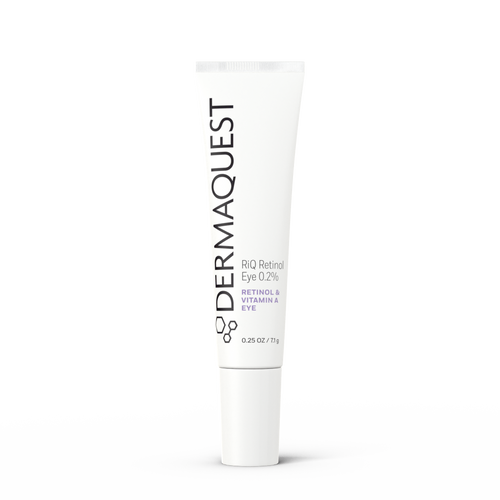
Step 4: Follow with Essential Moisturiser. If you want a retinoid specifically for the eye area, use RiQ Retinol Eye rather than taking the facial retinol close to the eyes.
Step 5: The following morning, finish with SheerZinc Broad Spectrum SPF 30 and reapply throughout the day as needed.
Last but not least...
Last but not least: be patient. While you may see some immediate benefits, it takes time and consistency to see results with retinoids, but once you do, you’ll be glad you stuck it out.